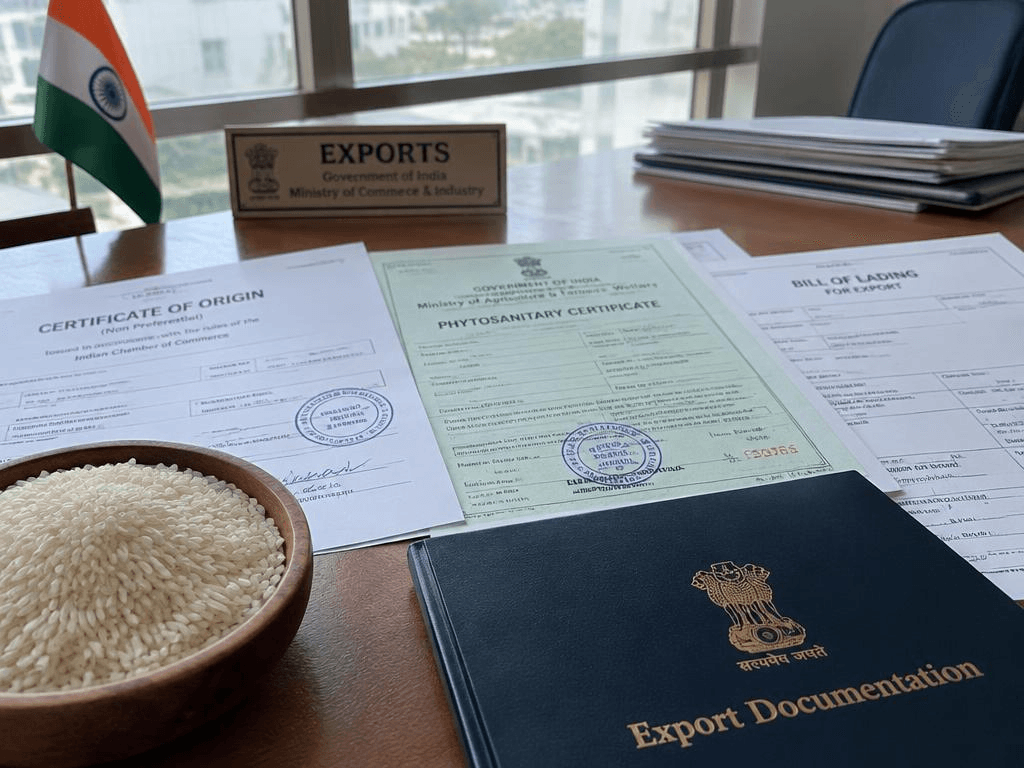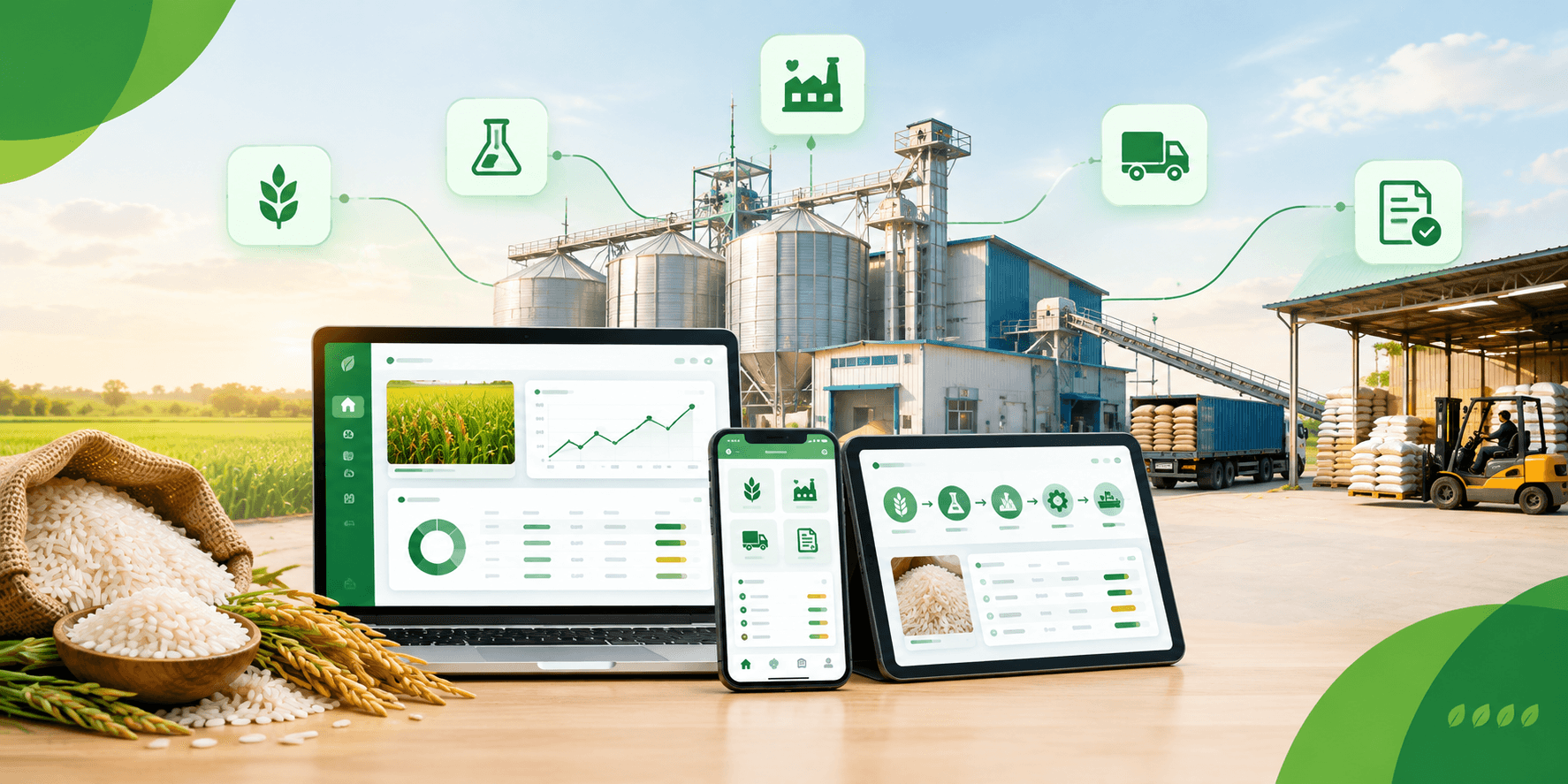
The most common rice export guides that you can find in India are document lists: IEC, RCMC, phytosanitary certificate, bill of lading. That's correct. But it's about the end of the rice export process, not the middle.
The documentation phase is not usually the point where export shipments get bogged down on most exporters' projects. Those issues begin weeks early when a truck arrives at the gate and someone records the weight, moisture reading and supplier's name in a register.
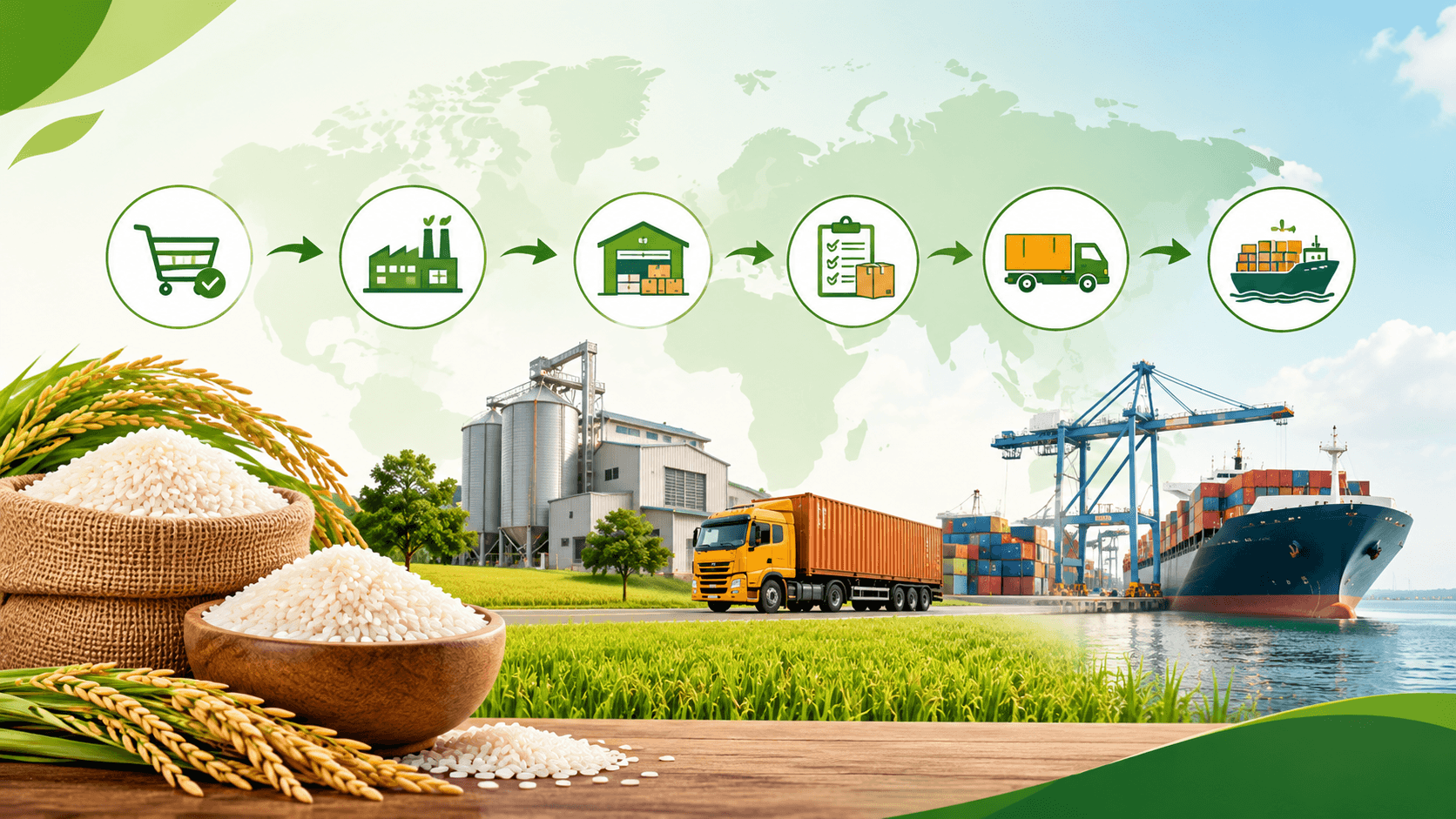
This article details the entire process of rice export from India, starting from the raw material purchase which forms the first link in the chain, to the shipping bill that seals the deal, and what happens in between when data from one link doesn't flow seamlessly to the next.
The Export Process Starts at the Gate, Not the Port
How do you understand the term raw material procurement in the context of rice export?
Raw material Procurement for rice export from India involves buying up of paddy or milled rice from the farmers, agents or mandis and assigning a quality-linked identity weight, moisture content, supplier place of origin and grade to the rice and this information accompanies the rice in milling, blending and dispatch.
The process of raw material purchase in the agro export value chain is by no means a simplistic transaction of a single unit. The export process involves buying commodities either at the mandi, via an agent or at the farm gate with the truck weighed as it arrives, moisture tested on the spot and the final quantity billed after deductions. The adjusted quantity and moisture reading will first show, or not show, on the commercial invoice, the phytosanitary certificate and the packing list.
It is important how that data is captured at the gate as it will affect the ease or difficulty of the entire export process in India downstream. If a gate entry has already been recorded accurately, and is legally correlated with the quality testing at entry, the exporter has done the hard work of compliance already. If the exporter writes it down in a paper register and types it back in later, he's working with two copies of the same record, and hoping they're the same.
How to create an Export Lot from Multiple Procurement Sources
Rice export shipments are not all from a single purchase. When a buyer in Saudi Arabia is specifying a particular quality for a Basmati container, the exporter who is sourcing the Basmati for the container is likely to use several purchase lots, from various suppliers, various dates of purchase, various quality readings and combine these into a container which satisfies the quality requirement.
The export process of bringing those lots together necessitates three records to remain connected: records of the raw material purchase data like weight, moisture, supplier), records of the quality tests conducted on each lot and records of production from milling or blending of those lots and finished products.
If these records are stored in different registers, spreadsheets, or even just in somebody's mind, the process of joining the export lot will be a manual effort for reconciliation. All quantities are manually checked. Quality certificates are manually matched to purchase records. Any lab records are checked for blending decisions. Not the documentation, but the data assembly which comes before it is this hidden cost of the agro import export trade, which is never mentioned in the export guides.
How export documentation is created from the procurement records
What is the export documentation process for rice export?
Rice export documentation process is one of the downstream activities of the procurement discipline. Each of the key documents in the import export transaction for rice are built from data that is recorded weeks earlier at the time of intake: the commercial invoice is based on the purchase weight and agreed price; the phytosanitary certificate requires information on quality at the lot level, registered mill details, etc. and the APEDA contract registration requires information on variety, quantity, and relationship of exporter and importer before the shipment is sent.
The problem is not a lack of export documentation for rice shipments, it is a mismatch of data between the procurement record and documentation. The phytosanitary certificate will fail the inspection at the shipping port if the quality test result(s) on record do not correspond to the tested lot being shipped, for example because the wrong quality test result was retrieved from the system or because lots were recombined without updating the quality test result in the system.
In the case of a commercial invoice quantity, it is compared to the shipping bill: a difference of even a few hundred kg due to manual re-entry between the purchase register and the commercial invoice is sufficient to cause the clearance. All documents that follow are derived from the raw material purchase record. With that record that is accurate and digitized with quality and dispatch, export documentation comes almost automatically. If it is not, then all documents are manual re-construction.
The Five Stages That Prevent Rice From Getting Exported
When it comes to operational gaps that cause delays in rice export from India it is often due to data-continuity gaps between the procurement stage and the port.
The difference between gate weight and shipping bill weight. Deductions for moisture taken at intake are sometimes not apparent in dispatch weight. The difference is realized by the shipping bill and will be matched with the commercial invoice in customs. A mismatch causes a query to be issued which may contain the container.
Traceability of lot numbers is violated. Any re-combined stocks would not be traceable to the correct stock lot at inspection if the stock lot number is not returned to the original stock purchase records during stock re-combination during milling.
Mill registration data missing at clearance. On shipments to countries such as the USA or China, a DPPQS mill registration is required. The mill record may not be attached to the dispatch of agro export goods from the beginning, instead it needs to be manually retrieved and this may delay the shipping of goods by days.
Variety mismatch in APEDA contract. All varieties must be registered with APEDA for the contract. Where the procurement is for multiple sub-varieties which form a blended product, the APEDA registration should be for the blended product and not the single purchase varieties. Exporters who register variety by purchase instead of variety by lot experience a mismatch at the downstream end.
LC settlement delay due to quantity mismatch. The quantity in the invoice, packing list and in the bill of lading must be the same to the decimal place, under the terms of the letter of credit. Any three way discrepancy arising from independent data entry at each step of the export procedure in India, delays the settlement of LC and utilizes working capital.
Questions About the Rice Export Process in India.
What is the rice export process from India?
The rice export from India process includes the following: procurement, quality testing, lot assembly, packing, shipping documentation, and customs clearance. It covers the process of raw material purchase, APEDA contract registration, issuance of phytosanitary certificate, stuffing containers and submission of shipping bills at the port. It takes 6 to 12 weeks for a standard shipment of rice export in India from the time of procurement until the ship leaves.
What is the impact of raw materials procurement on export documentation compliance?
All downstream export documents are derived from raw material procurement records. Commercial invoice, phytosanitary certificate and packing list are directly filled in with weight, moisture deductions, lot identity, quality-test results recorded during procurement. Inaccuracies or missing information in procurement records will carry through to the export documentation process and are most likely discovered at customs clearance, not during documentation.
What is the difference between agro import export and general merchandise export?
Agro import export is regulated by the commodity specific regulatory regimes under the APEDA oversight, Phytosanitary requirements and country specific residue and quality standards which are different from the general merchandise. There are also variable quality inputs in the agro export trade, as compared to the manufactured items with uniform specification, where the tracking of quality is necessary starting from the procurement stage till the dispatch.
What causes the errors in the rice export documentation at the procurement stage?
The majority of export documentation problems come back to data gaps at procurement, which include weight discrepancies due to inconsistent moisture deduction recording, lot number breaks due to manual recombination without updated records, and quality test mismatches due to the incorrect lab result being pulled at certification. When raw material purchase information is complete and linked with quality and dispatch information, correct documents are generated automatically during the import export process for rice. If those records are also kept separately and are then manually reconcilable, then it's pretty much inevitable that documentation errors will occur.
What is the entire export documentation process for rice export from India?
The export documentation process for rice from India includes the following: IEC registration (DGFT), APEDA/e-RCMC registration, APEDA contract registration per shipment, commercial invoice & packing list, phytosanitary certificate (DGFT/PQS), certificate of origin & shipping bill. Based on the destination, country specific Certification is included, such as Certificate of Inspection for EU, SFDA for Saudi Arabia. See AgroBrain's rice export documentation guide at for complete documentation breakdown.
Conclusion
The rice export trade pays off the export companies who get its fundamental aspects right on the eve of the port: procurement documentation is completed at the gate, quality testing is associated with the lot it is testing against, and dispatch information is from the same source as the invoice. Where those connections are, export documentation is automatically generated. If they don't, then each shipment requires a manual process of data re-construction that has been recorded but not in an accessible format.
Whereas for the agro import export exporter who wants to scale from a single buyer to multiple markets, the challenge lies between paper-based procurement and proper documentation. It all begins at gate entry and not at the customs counter.