In 2025 the rice industry in India reached a historical high. With a 19.4% increase from the previous year, India exported 21.55 million metric tonnes of rice, marking the highest volume of exports in the country's history. Basmati shipments beat a record high of 6.4 million tonnes while non-basmati jumped 25%. There is a demand for that. For any rice mill owner and/or rice export manager, the question is whether they are prepared to catch up with it.
Most aren't. The difference is not between the supply of paddy and the demand for it, it's the internal processes: procurement was recorded on registers, experience-based blending decisions, dispatch was organized with WhatsApp, and lab reports were not always in sync with the production floor. These inefficiencies are manageable at 10,000 tonnes/season. They become a ceiling when they are at the scale of India's rice export industry that India is going towards.
Rice mill ERP software does just that. This article describes what it is, how it operates, the criteria to use when considering one and why the AI-based ERP generation is a new product line compared to what most mills are familiar with.
What is Rice Mill ERP Software?
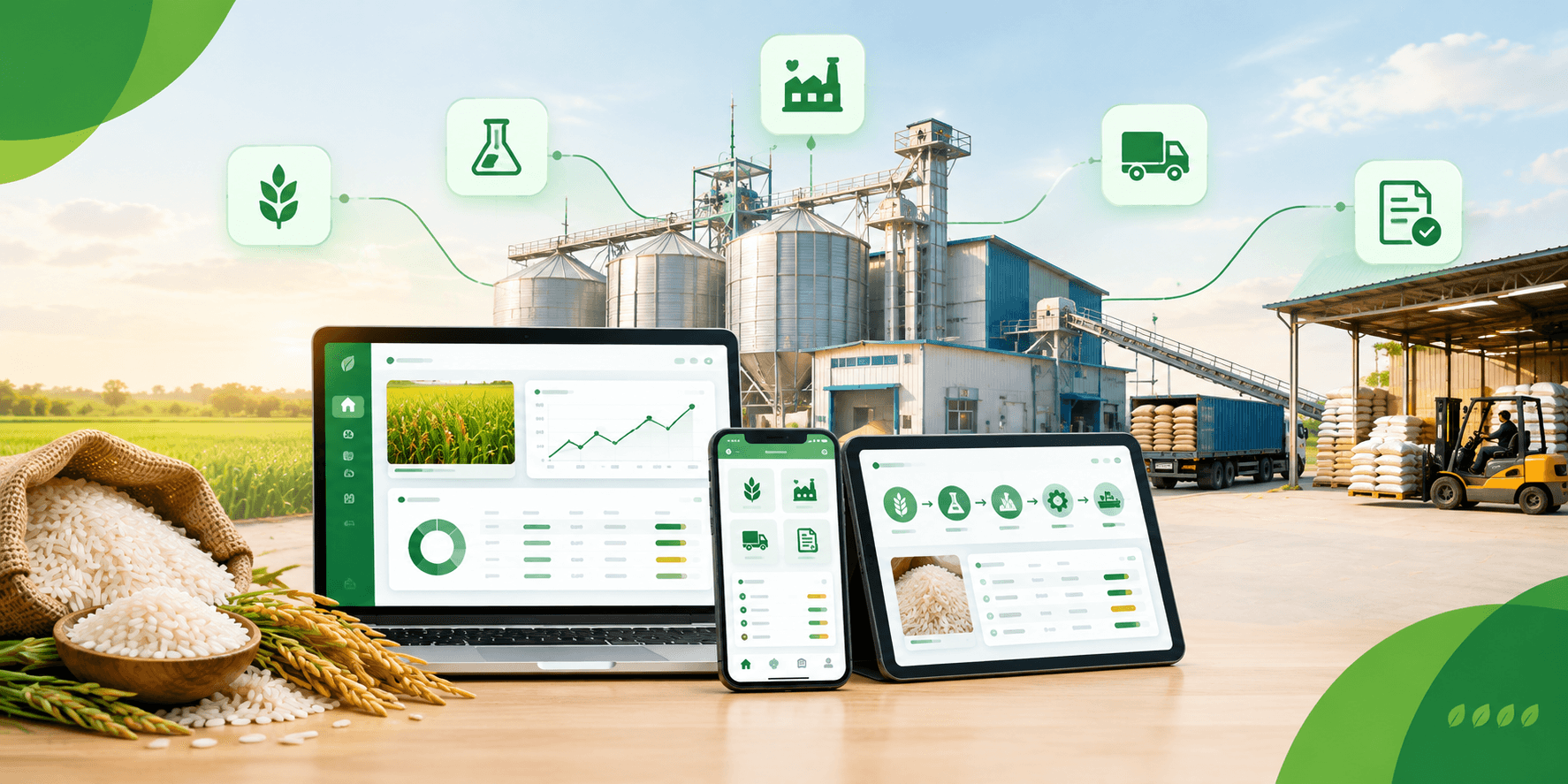
Rice mill ERP software is a specialized ERP solution created to cater to the operational requirements of the rice milling and export industry. It integrates the disparate system of spreadsheets, paper registers, and messaging applications that most mills use today into one single connected system from the time a loaded truck enters the gate until a loaded truck leaves the gate, covering everything from procurement, to quality testing and blending, to production, to inventory, to export documentation.
It is an ERP system software designed specifically for the rice mill industry, and surpasses generic tools by a long shot. This is not the same as an all-purpose manufacturing ERP system made Agriculture friendly. A purpose built rice mill ERP knows the industry's workflows, such as paddy procurement from several suppliers with different moisture content and quality grade, lab based quality decision and its impact on blending, hopper based production process and export documentation parameters which differs from country to country based on the buyer. For this generic ERP platforms need to be heavily customized. Specialized rice mill ERP platforms build it from day one.
Problems Rice Mills Face Without ERP
If you are running or own a rice mill, the above list will come as no surprise – not as hypothetical problems, but as problems that occurred last week.
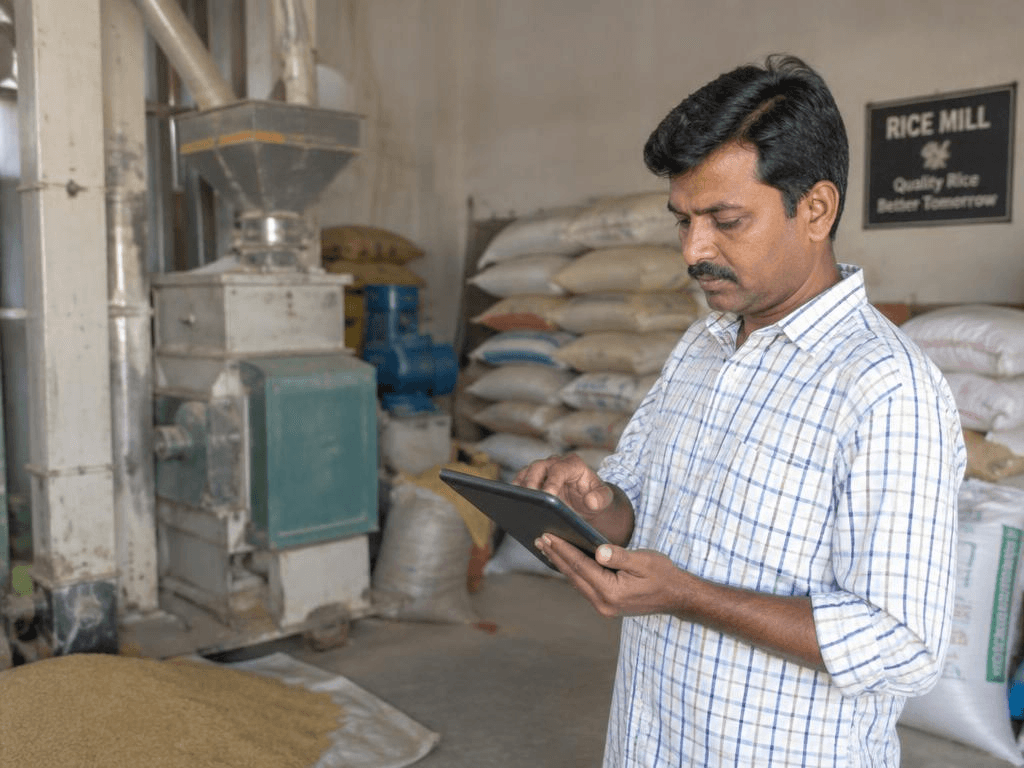
Procurement is Paper Heavy and Slow There is a lot of paper involved and procurement takes too long. Paddy comes in, a slip is taken and a copy of this slip is re-entered into a register or into an Excel sheet hours later. The information is already out of date when it gets into any system.
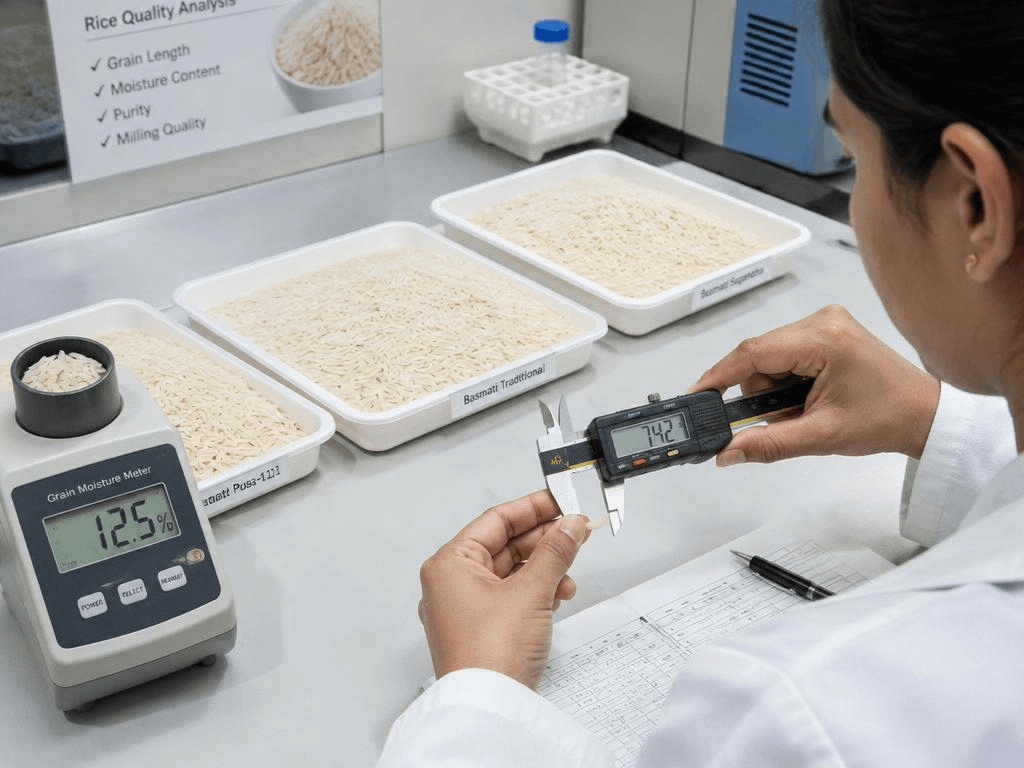
Quality is Determined Subjectively The lab does moisture, length and cooking-percentage testing but results are recorded in a lab notebook, which is not always brought to the production floor in real time. Blending decisions made based on who's available and what they remember, not based on systematic comparison of what's available.
Blending Wastage Compounds Quietly A blend that does not meet buyer requirements by a small amount doesn't trigger an immediate alarm. It creates a rejected shipment, a renegotiated price, or a buyer who will go elsewhere for the next season. The wastage of inconsistent and experience dependent blending is real but invisible until it is too late.
Dispatch is chronically delayed Proforma invoices, challans and loading schedules are manually typed, and sometimes by different people from different records. Poor communication between the purchase team, production team and dispatch team is a common occurrence.
Inventory Counts Never Match When everyone adds up what is ordered, prepared, shipped and still in the bin the totals are already three days out of date!
They're not failures of the management, they're failures to operate the high throughput, multi-step operation on tools designed for simpler work. ERP software is not a business management solution, it's a business information solution.
How ERP Software is Revolutionizing the Rice Mills Operations
A well implemented rice mill ERP unites all the departments of the rice mill in one record of purchase, lab, production, inventory and dispatch. Let's take a look at how that connectivity evolves, bit by bit.
Procurement and gate entry become automatic. On arrival of a vehicle the gate operator enters the vehicle details. Weight, supplier and grade are recorded one time only. Changes to inventory are automatically made when the vehicle is unloaded. The purchase manager doesn't re-enter anything the data flows forward from that single entry.
Quality testing feeds into the production. Moisture content, grain length and cooking percentage are provided by the lab manager and are instantaneously accessible to anyone who needs them: blending, sales generating a PI, production scheduling a run. The lab book is no longer the choke point.
Work orders are not created based on phone calls, but on approved blends. When a blend is approved, the production work order will be completed automatically. Hopper load assignments, production run objectives and finished goods records all refer back to the same approved blend – no re-keying, no transcription error, no version mismatch between what was planned and what the production floor received.
Inventory is live, not monthly. Real time stock control software keeps a record of stock movement, stock additions by procurement, stock draws at production and stock removals at dispatch. All facilities of multi-location operations appear in one view. Wastage and surplus are accounted for as they occur and not at the end of the month.
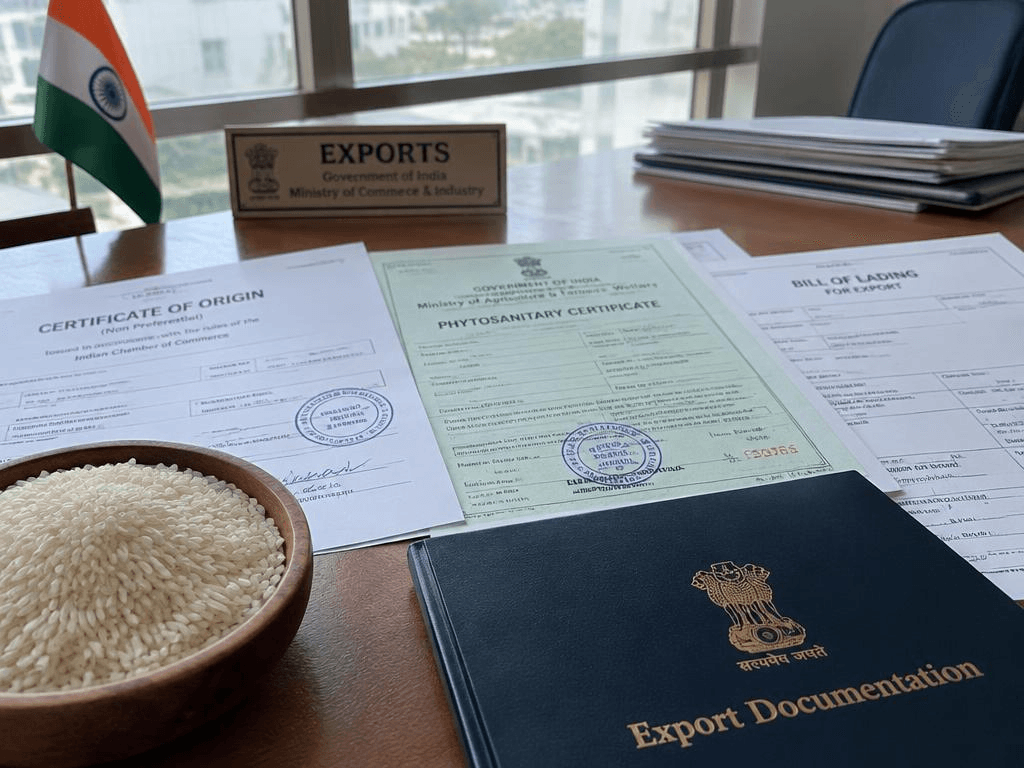
Export documentation automatically created. Purchase orders, proforma invoices and challans are generated automatically from the transaction, rather than being typed separately. Paperwork is prepared when the truck is ready to move. This helps rice exporters having to deal with APEDA requirements, certificate supporting documents and buyer specific compliance that can make for a smooth customs clearance or a delayed shipment. Watch the end-to-end solution of AgroBrain on the Export Compliance & Documentation page.
The AI Advantage: What Most Rice Mill ERP Still Misses
In the rice industry, most ERP are automated to record and report what has been done faster than a register: Next generation rice mill ERP software takes things a step further; it tells you what to do next, before you need to make a decision.
The most obvious example of this is AgroBrain's AI Blending Engine. Instead of a lab manager making a manual comparison of the available lot profiles to a buyer's specification, AgroBrain takes the buyer's requirements and cross-references them with all available lots in a data-backed approach, which can deliver a blend recommendation in seconds.
The practical impact:
If blending decisions are made in one lab manager's brain, that brain walks away when he retires, falls ill or when he leaves. If blending decisions are made live to a system which has been trained on historical stock profiles and buyer specifications, the knowledge remains.
That's what makes an ERP which is designed for rice different from a manufacturing ERP with a rice module. To learn more about the details of how AgroBrain's blending engine work, check out the AI Blending Engine page.
What to Look for When evaluating Rice Mill ERP Software
When considering implementation of ERP platforms, it is easy for decision makers at rice mills and rice export companies to consider the surface features of the modules, price and support SLA without giving a second thought to what they really need to consider to make the implementation a success. This is the more important thing.
Is it designed for rice export or manufacturing as a whole?
The task of customizing a generic manufacturing ERP system to accommodate the rice workflows like APEDA compliant export documentation, quality-grade-based procurement pricing, production through hopper, etc. is a massive challenge. Each customization is a future expense for maintenance. A rice exporter ERP designed specifically for the rice exporters comes with these workflows built-in.
Will it integrate lab information to blending to production in real-time?
The most prevalent data gap about the rice mill operation is the gap between knowledge and operation in the lab. If the ERP software that you're looking at just has these modules in their own distinct structure and will require manual bridging, you are not addressing the core issue.
Is it capable of multi-location operations?
If you run more than one mill or warehouse and/or dispatch point, you need real-time stock management visibility across each of them from one location. Before committing, ask them specifically how this works.
What do rollouts really look like?
A typical implementation of AgroBrain can take 4–6 weeks, and will include a dedicated AgroBrain specialist. A six-month configuration ERP with a third-party implementation partner is not the same investment commitment, and is something to be understood before signing.
What if the internet shuts down?
Rice mills do not stop when there is a drop in connectivity. Gate entries, production logs and dispatch records must continue. For most mill environments, having an ERP that can operate without an internet connection, and then sync automatically when Internet connection returns, is simply a requirement of doing business, not an option.
To view an end-to-end overview of how AgroBrain meets each of these criteria, refer to the AgroBrain Platform overview.
Conclusion
Rice mill industry in India has entered into an export cycle it has not experienced for years. It will not be the milling companies or export companies with the best harvests; it will be the companies with the most efficient operations: blending decisions based on data, documentation in place before the truck loads and inventory count matching reality in real time.
That's possible thanks to rice mill ERP software. It is a change from most mills that has evaluated it before that it is AI-generated, and that the system not only records what happened, but suggests what to do next.
Looking to experience AgroBrain on your operation? Schedule a free demo and discuss your procure-to-export process on your data, not a sample data set.
Frequently Asked Questions
What is Rice Mill ERP Software?
Rice mill ERP software is a specialized enterprise software solution that automates the entire working of a rice mill from raw materials procurement, quality testing, blending, production, inventory management to export documentation, eliminating multiple manual registers, spreadsheets, and WhatsApp communication with a single system.
How does ERP software help reduce wastage in a rice mill?
ERP minimizes wastage in two different ways. First, AI-powered blending recommendations rely on actual stock data and buyer specifications to create optimized blends, and don't suffer from over-blending or specification misses that can occur due to experience-based decisions. Secondly, real-time inventory tracking identifies discrepancies in real time instead of them becoming apparent in monthly inventory reconciliations, by which point the loss may have multiplied.
What are the features to be kept in mind while purchasing rice mill ERP software?
The key features of a rice mill or rice exporter company are: Quality linked procurement (Lab Results directly fed towards blending), AI-driven blend recommendations, Automated work order generation, real-time multi-location inventory, and Auto-generated export documentation (PO, PI, Challan). Functionality to access the system offline and by role is standard, not optional.
Does Rice Mill ERP software make sense for a medium scale business?
The straightforward answer is, it depends on whether you are able to identify specific losses which are detrimental to operations. You can confidently make the ROI case if you're coordinating procurement, quality and dispatch across teams via WhatsApp and phone calls, and are experiencing mismatches in inventory counts or blending wastage you can't account for. When there is only one facility, one buyer and no observed failures in coordination, the calculation is less evident.
How much time does it take to implement a rice mill ERP?
Typical implementation of AgroBrain is 4–6 weeks, including Onboarding, Training and Go-Live. The majority of team members attain working proficiency in two weeks after purchasing.
Book Your Free Demo → | +91 99834 97088 | contact@agrobrain.in