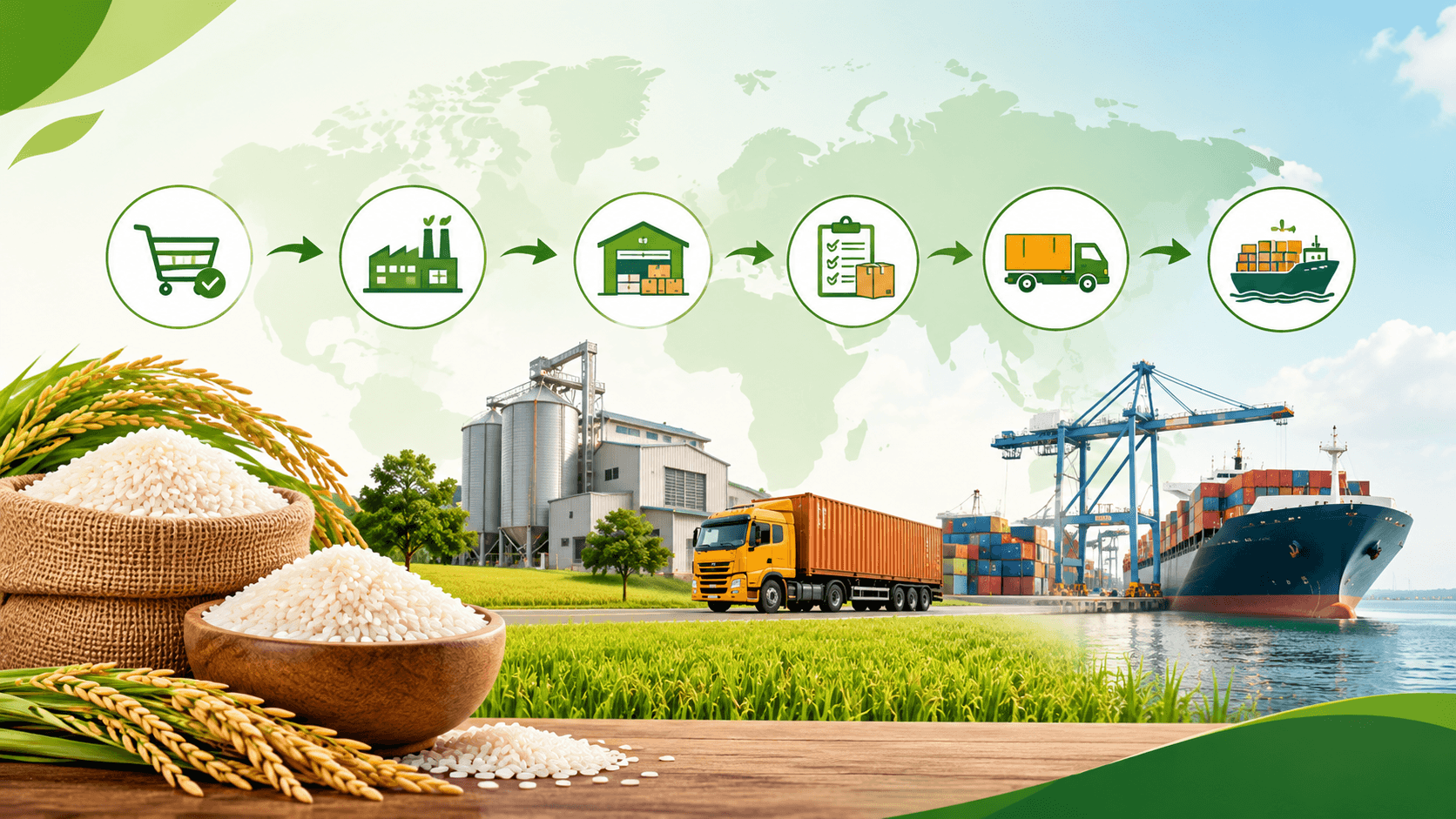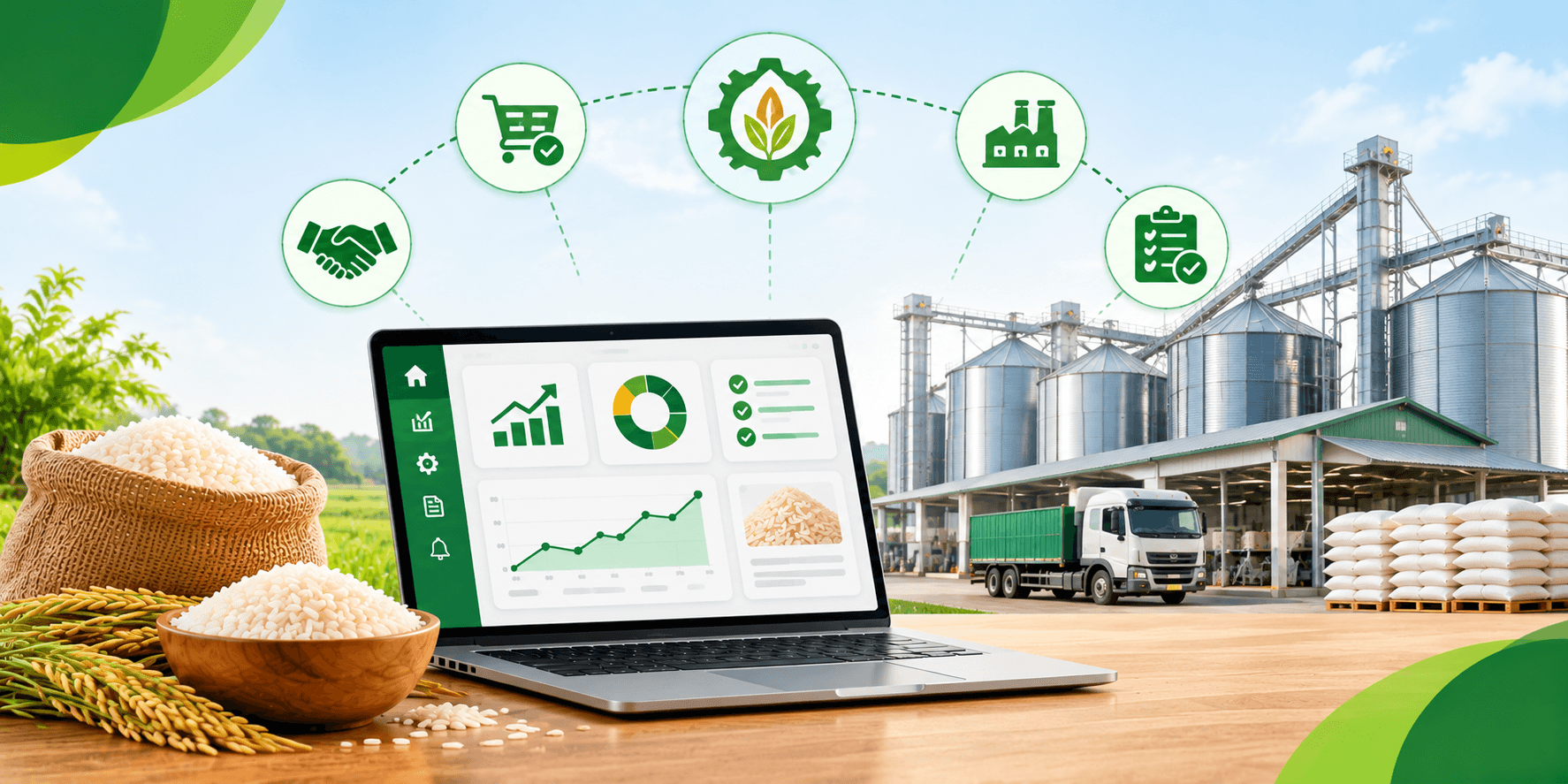
Rice Industry in India exported USD 12.47 billion worth of rice in 2024-25, behind every shipment of rice is a set of rice mills, which is in charge of procurement, quality testing, blending, production and documentation under a single roof (APEDA/IREF, via Devdiscourse, October 2026). Estimates suggest that there are 80,000+ rice processing units in the country, and this is no longer a decision on investing in ERP software, but an operational decision: Mills not using ERP software are losing yield, documentation accuracy and buyer trust.
The more interesting one is which one ERP software is actually appropriate for a rice mill and not a generic manufacturing solution, or as the software vendor would say, not the description of what they claim that their system ‘supports’ agri-processing of.
Key Takeaways
Unlike discrete manufacturing, the rice mill industry has a completely different set of data: each lot that comes in will have a different quality profile; each blend will be unique; the inventory value will change as moisture and varieties change but not as quantity changes.
Generic manufacturing ERP software has a fixed bill of materials. There is no fixed BOM for rice milling; it has variable quality inputs, multiple by-product outputs, and blending logic which varies over each procurement cycle.
Six capability tests are common to all rice mill ERP systems, six others are specific to the rice mill ERP and only the best ERP software for rice mills is capable of this: mandi based raw material procurement, quality linked blending, variety level inventory management software, Milling yield tracking, export document automation and offline gate operations.
Why Rice Mill Industry Cannot Run on Generic Manufacturing ERP
Manufacturing ERP software is logical and centers around the following core operations: create a bill of materials, plan manufacturing runs, monitor inputs used, document finished goods produced. That model is clean when the inputs are standardized. It cleaves easily in the rice mills.
The moisture content, grain length and grain profile are different in each truck load of paddy that comes to the gate. What is required to fill a buyer's order will vary depending on the lots available and the quality testing they've passed, and not by a set formula. The inventory is maintained in terms of variety (1121 Basmati, Pusa 1509, Sona Masoori), compliance (RCAC registration per variety) and quality grade. During the milling of paddy, the product is not just rice; it is head rice, broken rice, bran and husk with individual market values.
Most rice mill companies using a generic ERP system software spend the first year configuring it to support these basic needs, and even after that, these customizations are "on top" of a data model built for a different purpose. The other option is to select top ERP software that fits rice mill processes, where these workflows are not an afterthought, but a prerequisite.
The Best ERP Software for Rice Mills comes with 6 capabilities
A raw material procurement system which supports the native transactions of mandi.
A rice mill raw material procurement isn't a purchase order followed by goods receipt. IN a mandi deal: paddy is purchased from a commission agent (arthia) and deductions are made at entry into the mandi due to weight loss owing to moisture, bag weight, and possibly cleaning allowance. The price quoted on the invoice is not the landed price, but the landed price after deductions which depend on each truck and each supplier.
It's not possible to model this without customizing ERP software that processes a standard goods receipt. The best ERP software in India for rice mills records the weight of all the users entering through the gates, deducts moisture loss from the weight to determine the net quantity received and automatically posts the corrected cost. The weight of the truck and what is loaded into it are two separate numbers and must be recorded.
Quality Testing Linked Directly to Inventory and Blending
A quality test is conducted on all lots of paddies for moisture content, grain length, head rice yield and aroma grade of Basmati. The results will indicate the value of the lot and the buyer's requirements it can satisfy.
With a disconnected workflow, the lab results are stored in a different register, and a blending decision is made in memory or by manually creating a comparison. Purpose-built ERP system software connects the quality test to the lot record where the test is performed so when a buyer's specification is added to the system, it has the current quality profile for each available lot, not a summary compiled last week.
Inventory Management – By Variety and By Compliance Statuses
Generic inventory management software is used to record quantity in terms of SKUs. That's just a fraction of the equation for rice mills. A complete inventory record records:
Variety 1121 and Pusa 1509 are not interchangeable, and the use of both requires the variety to be covered under APEDA registration.
Compliance status: A lot that is compliant (has a valid RCAC) and a lot that is not registered cannot be committed to the same export shipment.
Quality grade: Any premium grade lot that a system tags as a commodity order is an opportunity that was lost in the grade.
The best ERP software for manufacturing in India and specifically for rice includes tracking of all three at the lot level. An inventory query will not only return a tonnage value for a variety, but the tonnage that will be RCAC covered and quality tested and available to a buyer variety spec.
Milling By-Product and Yield tracking
The most consistent factor of untracked value leakage in a rice mill company is milling yield variance. The milled paddy is divided into head rice, broken rice, bran and husk. The ratio of milling yield changes according to paddy varieties, moisture (before milling), and milling conditions. The 68% head rice versus 65% yield on a 1,000-tonne run is a big difference and is seldom traced to a lot or cause.
In the case of manufacturing, generic manufacturing ERP software keeps track of what goes in and what comes out of production. It does not account for multiple by-products for each production to run or for variations in the milling yield for each lot. Each run's actual yield head rice, bran, husk is recorded on a purpose-built system to compare against that lot's theoretical yield, so there is a visible actual yield shrinkage that is truly attributable, rather than a month-end mystery.
Export Documentation Generated from the Same Lot Record
For mills engaged in exporting these documents is necessary to back up every shipment: proforma invoice, packing list, challan, and supporting quality records. The mismatch between these is the major operational port rejection and customs delay reason, whenever these are generated from various data sources like invoice from sales order, packing list from weight record, invoice manually from dispatch at challan.
These documents are automatically created from the rice mill transaction record by the top ERP software for rice mills, the same lot information that was inputted during procurement, the same lab result that was attached to the lot, and the same weighbridge weight that was confirmed during the transaction. No opportunity for mismatch (because there is no re-keying).
Functionality at the Gate – Offline.
The geographical spread of the rice mill industry in India has been found to be uneven; most of India's rice processing capability is located away from Tier 1 cities where power and internet reliability is found to be low. Best ERP software in India for rice mill operations should be able to operate offline for certain operations like gate entry, weigh bridge capture and stock update on vehicle arrival. Data is synced automatically once the connection is re-established.
Any ERP system software to be used to record a vehicle's arrival is developed in an office, not a rural milling facility. This is a need, not an option.
Questions to Ask Before Deploying a Rice Mill ERP System from any ERP vendor.
These are 6 questions that can quickly differentiate an purpose built ERP software for a rice mill company from a generic ERP solution
How do you deal with moisture deductions in the procurement of raw materials in your system? Customization is a no-no if the answer is customization.
Are Quality test data automatically delivered to blending recommendations? The same disconnection that exists on paper is replicated in the digital repository of lab results when they are not connected to blending decisions.
Is there a way to keep track of inventory by variety and RCAC compliance status? In the case of a vendor who does not know RCAC, he or she has not constructed for rice export compliance.
How is the bran and husk and broken rice generated in the milling process monitored on a per-run basis? If yield tracking is an accessory, it will not be done on a regular basis.
How to create proforma invoices and challans? The right answer is 'from the same transaction record as dispatch. All answers that require manual data entry carry a mismatch risk.
Is there an offline mode of operation for the gates? Otherwise, request references from mills where there is continuous connectivity at each gate.
Frequently Asked Questions
What is the best ERP software for rice mills in India?
The best ERP software for rice mills in India are specially designed for the rice milling process, ranging from raw material procurement from the mandi with moisture deduction facilities, lot level testing facilities for quality testing with option to blend, variety level inventory management software, tracking of milling yield, generation of export documents, and offline gate operations. While some of these are addressed by generic ERP software, it doesn't address them all, as the data of a rice mill is quite different in nature from discrete manufacturing data.
What is the difference between ERP Software for rice mills and other manufacturing?
For discrete industries, manufacturing ERP software is based on a predefined bill of materials. The inputs are variable quality (all lots of paddy are different), the blending logic is variable (all buyers' specs are different), and the output is variable (milling yield varies by lot and variety). The data model required for ERP system software for rice mills to address this variability in the Indian rice industry is different.
What are the key features in top ERP software for rice mill businesses?
The rice mill company needs to consider the following six characteristics of rice to select the top ERP software: mandi procurement handling process, quality-test-to-blending linkage, variety-level inventory management, by-product and yield recording during the milling process, export document generation automatically based on lot records and offline gate. Two or three of these are usually managed by generic best ERP software for manufacturing in India while purpose-built rice mill software manages all six.
How ERP software is beneficial for the rice industry in India in terms of inventory?
The ERP software for the rice industry in India offers inventory management software that records the stock of rice varieties, quality grades and APEDA compliance status, besides the quantity. This is important when deciding if lots can be blended to meet a buyer's specification and/or when determining whether lots can be available for a shipment, according to the RCAC.
Will there be any ERP software in India specially designed for the rice mill operations?
Yes. The difference from the generic best ERP software in India is that the purpose-built software for rice mills is built for the mandi procurement, quality-led blending, tracking and monitoring of the milling yield, and compliance with APEDA for export. In the case of the rice mill industry, it involves quicker deployment, lower customization costs, and a system that is in line with the actual working procedure.
Conclusion
The rice mill industry in India is operated with such complexity that it requires level of complexity which generic ERP system software was not designed for. Milling yield variance, export document accuracy, variety-level compliance tracking, lot-level quality testing which influences blending decisions and moisture deductions while ordering are not modules to be added to a general manufacturing system; they are the heart and soul of the right system.
The best ERP software for rice mills offers these workflows from ground up. If a rice mill company is considering using one of the above capabilities, here are the six tests to see if the system was built for this business: pass all six, and it was built for this business. Well, most of them, you had to do some workarounds, and it was not.