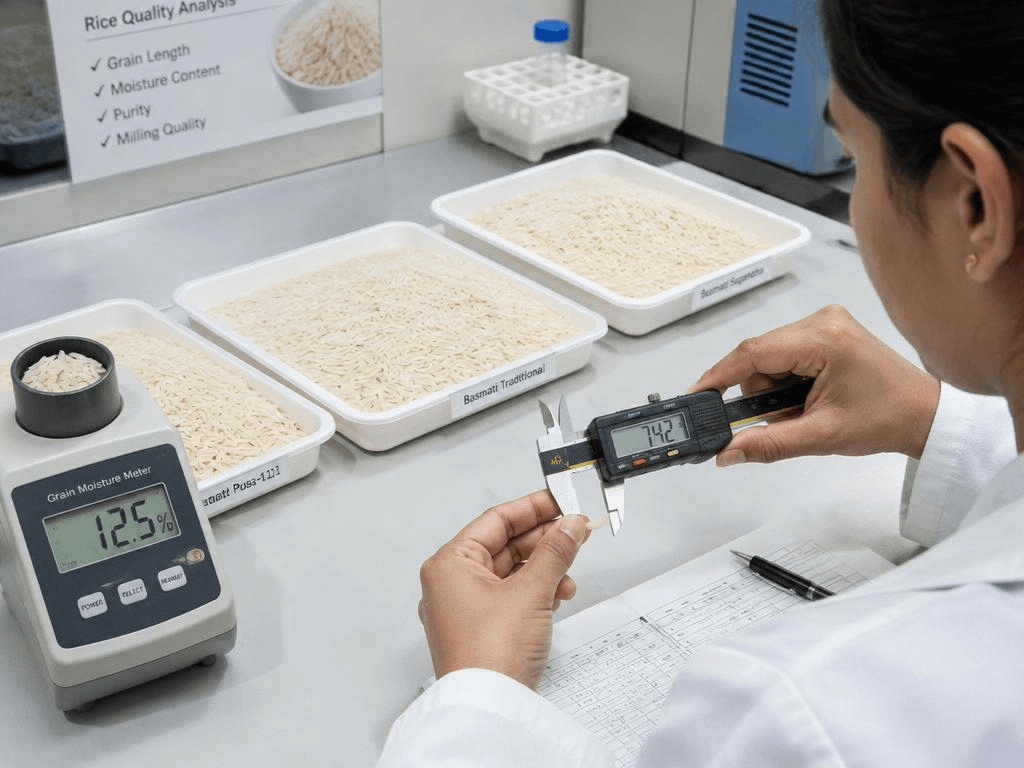
One of the most important and least data-driven decisions in the rice export business is rice blending. Most mills, unless they have a large number of specifications, are dependent on a lab manager who is familiar with the stock in the mill and can estimate a blend ratio to satisfy a buyer's specification. If that person is correct, the operation is executed. If they over-build to be safe or their blend doesn't meet the spec and has to go back for re-work, the raw material is quietly lost and no one records the amount used.
This guide will examine the three distinct ways manual rice blending creates waste, how AI-based rice blending overcomes each of those obstacles and how rice mill ERP software must play a role in blending optimization in order to impact any measurable aspect of raw-material costs.
Where Rice Raw Materials Waste Actually Happens in Rice Blending
The first step to rice milling waste reduction is to know the sources of the waste. Blending is a process that goes through three steps in which the raw material is lost without ever being mentioned in a conventional loss report.
1. Over-specification waste. If a buyer requires rice to be a certain length and cooking percentage, the proper answer is a mix that is just a little under those specs. A lab manager who is creating a blend from scratch will also build in a quality buffer, he will use a higher grade stock than he needs to in the specification as he wants to be sure that blend will pass inspection. That's a buffer of loss. Premium stock was used to over-build quality, with a higher landed cost and the value differential between "meets spec" and "exceeds spec" will never be recouped at sale as the buyer is only paying for what is specified, not what is delivered. This is usually the highest per-year avoidable raw-material cost throughout an entire year of exporting.
2. Lots of fragmentation waste. If blending is not directly tied to a live inventory program, lots are used in part but left unused. A 500-tonne lot which was processed for one blend, then some for another, and then some for another, turns into a 30-tonne remainder that is too small to blend cleanly, too expensive to waste and not recorded accurately enough to be sold separately. Lot fragmentation receives no attention until at the end of the month, when it shows up as an unexplainable stock difference, which is typically not considered a wasted dollar.
3. Re-blending cycles. If the blend is mixed and subsequently fails the quality check, due to a wrong moisture reading after bagging, the material goes back. Re-blending the same stock is a labour and energy expenditure, but more relevantly, it's a physical strain on the grain that will lead to an increase in brokens, so that the lot will produce a lower head rice yield. A small portion of material is converted from head rice to broken rice quality during each re-blending cycle. This downgrade accumulates when re-blending occurs on a weekly basis in a mill.
Why Manual Blending Can't Solve A Multi-Variable Optimization Problem
Rice blending optimization is a very complicated calculation. There are at least four parameters, namely, grain length, moisture content, cooking percentage and aroma covered by a buyer specification for export Basmati. Every incoming lot in your stock has a profile on the same four dimensions. The blending problem is to determine the proportions of the available lots in certain given ratios which will result in a blended output meeting a given specification, but not using more high-grade stock than is necessary.
A human is able to remember 2 or 3 lots and approximate a ratio that clears a spec. Five or six lots of varying qualities, in varying warehouses, the possibilities exceed what any one person could evaluate with accuracy. It's not a wrong choice, but it's a safe and conservative choice that is better than spec but is going to require more of the higher cost stock than the optimum choice. The price is that of being conservative.
AI-based rice processing software is not an approximation. It compares all the available lots of the current stock, assigns weights to the various quality parameters, and determines the blend ratio which will satisfy the buyer's specification at the lowest raw-material cost from the raw-material profile data exactly as they exist in the current stock on that day and not based on any memory or habit.
In fact, machine-learning models can analyze over 60 yield factors in real time per batch, according to a 2026 Infor report on AI yield optimization in the food manufacturing industry. That processing depth is what separates a heuristic which remains safe from an optimization which remains true.
What AI-Based Rice Blending Actually Does The Mechanism
One of the most prevalent misconceptions about rice blending software that leverages AI is when users think it replaces the labor manager's expertise. It doesn't. Can replace the lab manager's memory.
The process consists of four steps:
Step 1: Buyer Spec input. The buyer's desired parameters (length, moisture, cooking percentage, or any export market specifications like aroma grade and broken rice tolerance) are entered by the lab manager.
Step 2: Stock profile matching. The AI engine scans all existing lots from all warehouses and extracts quality information for each lot from the last lab sample and determines which combinations will satisfy the buyer's specification.
Step 3: Optimal ratio output. The engine pulls off the matching combinations and returns the correct blend ratio from the available combinations while spending the minimum number of expensive parts and not exceeding the required spec. The lab manager is able to view the recommendation with the quality of the recommended output.
Step 4: Generate a work order. If the lab manager approves, then the blend recommendation is automatically transferred into a work order. The exact number of lots and quantities are verified. Nothing is re-entered.
It is the blending module in the rice quality management software that distinguishes it from a generic WMS or a spreadsheet system; the quality data is in the same system (WMS) as the blend decision, and the result of the blend decision is directly actionable without a transcription step.
How Rice mill ERP Software Closes the Loop on Waste
A stand-alone blending recommendation or a standalone spreadsheet for blending recommendations does not decrease waste. It helps to make the most of the blend decision at that time but it does not record the effect on inventory and procurement. Only the reduction in waste is measurable when the blending decision is linked to what occurs before and after the blend.
Rice mill ERP software integrates AI blending decision into three interconnected layers:
Prior to the inventory drawdown of the blend. If the blend recommendation specifies specific lot and quantity, they are reserved from live inventory on the spot. The stock will not be available at another location for a conflicting blend decision. This overcomes the double allocation problem that occurs when stock is found to be already allocated elsewhere.
During the blend lot consumption tracking. The system generates the data of lot-level consumption, such as which lots were used, how much, and what the actual output weight was, as the blend runs. Lot fragmentation waste becomes apparent here; the waste is identifiable by lot rather than by general-stock waste.
After the blend procurement signal. Rice mill automation software has the ability to send a procurement signal to the mill, which means what to order, from what quality, to allow for the optimal stock profile over time when there is a blending pattern. This is where AI blending will save not only on the price of a single blend, but on the price of stocks of raw materials.
The manual process cannot close the supply-chain loop between AI blending decision and inventory record and the procurement planning process. Documentation used for export compliance, including APEDA requirements is also a lot-level trace from a buyer's shipment all the way back to the original paddy purchase.
What are the changes in the first 90 days?
The impact of rice processing software using AI blending is not proportional.
The first 30 days are accomplished with fewer re-blending cycles. Blends using actual stock data have a lower failure rate for lab checks than blends that use approximation data because the same set of quality parameters are used to calculate the blend and to measure the sample for lab check.
After 60 days, it's not just a feeling, but a number. Since lots are tracked through all the blends, the stock report can display the remaining quantity of lots in each blend instead of the total quantity. The 30-tonne remainder that was lost to a stock difference is now a named lot with a known quality profile that can be offered for the next blend whose profile is the same.
Procurement pattern changes after 90 days. The purchase team can view which quality tier is moving fast and which is not moving, and they can take into account the stock profile created by the AI when making purchases, instead of relying on past buying patterns.
The Bharat International Rice Conference (BIRC 2026) pointed out that even a 1% increase in head rice recovery, which is directly aided through improved blending, increases the value of a mill processing 30,000 tonnes of paddy by about ₹60 lakh per annum (Outlook India, October 2026). This is an actual result of the rice milling waste reduction, not a projection.
Conclusion
Manual rice blending is not inexact, it is restricted. A good lab manager who builds from memory is operating a multi-variable optimization problem while at the same time having incomplete information, and his/her conservatism is warranted from what he/she can see. The waste is not their fault, it is simply a consequence of making the decision without the data.
The rice mill automation software transforms what that decision is based on, with an AI blending engine. It doesn't give judgment, it gives judgment accurately and completely for the first time. But when that decision relates to inventory tracking, lot management, and export documentation via rice mill ERP software, the waste reduction becomes measurable, traceable, and cumulative.
Frequently Asked Questions
What is rice blending software?
Rice Blending Software is a program that accepts the quality specification length, moisture, cooking percentage, aroma from the buyer and matches it with the stock quality nominated and provides the optimum blending ratio. That recommendation is then seamlessly linked to inventory and work order generation through purpose-built rice blending software, making it both traceable and actionable.
What way does waste get reduced by AI rice blending?
AI rice blending minimizes waste due to the lack of conservatism in the manual blending decisions. If a lab manager cannot keep all the quality profiles in his/her head, he/she creates a quality buffer, which is an over usage of the premium stock. AI determines the precise combination which fits the spec without that buffer for a lower per-shipment raw-material cost.
What is the difference between rice blending optimization and normal blending?
The blend is made following the standard blending and it passes quality inspection. Rice blending optimization is the most suitable ratio of the rice blend to be qualified, with the minimum cost of raw materials, based on the current inventory profile instead of the fixed recipe. The difference becomes apparent in terms of stock utilization and over time the decrease in lot fragmentation waste.
How is it that rice processing software should be integrated with ERP?
Blending effects inventory. Rice processing software will record a blend recommendation but will not update this inventory record, and there will be an incorrect stock available for the next blend recommendation. Rice mill ERP software ensures that the blending module, the inventory ledger and the work order are in a connected system so that every blend decision is based on what is actually in stock, and not what was in stock yesterday.
What does rice quality management software have to do with waste reduction?
The data that the AI uses to make its blend recommendations is stored in the quality profile of each lot of rice that is brought in and stored in rice quality management software. The lack of accurate data in the system will cause inaccuracy in the AI optimization, if it is outdated. The key to measuring AI blending waste reduction is live quality data, which can be tied to live inventory.