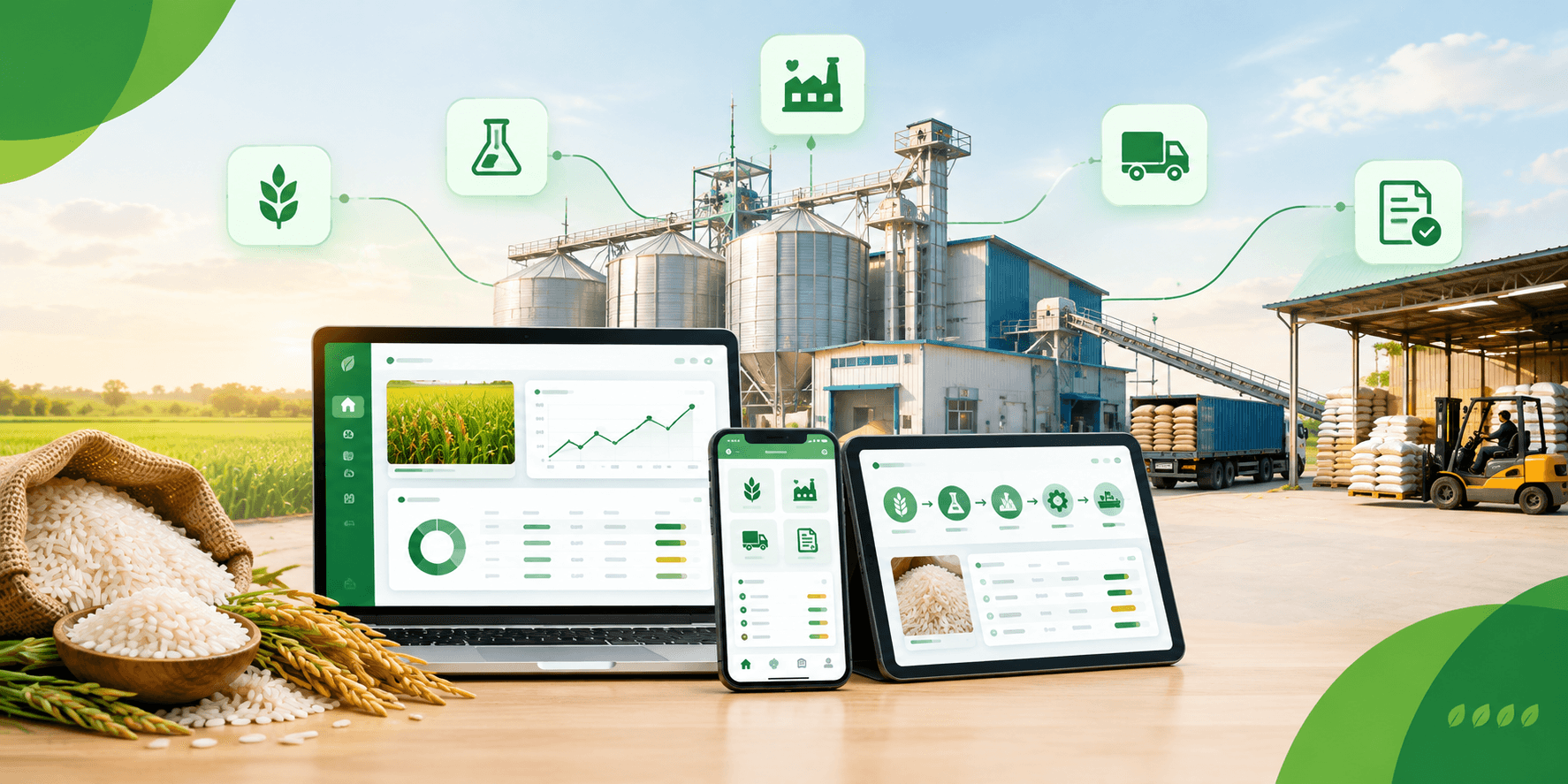
Running a single rice facility is a counting problem. Running three milling units, with a storage godown and a dispatch point is a coordination problem. Until the mismatch in stocks becomes an actual loss of shipment, most rice exporters don't realize that difference.
This guide explains the various issues that occur in multi-location rice operations, what real inventory control entails at this level of scale, and how the purpose-built rice inventory management software differs from the general-purpose warehouse software.
Why A Multi Warehouse Rice Inventory is more complex than a generic Warehouse Management
e-Commerce and distribution companies averaged just 83% accuracy in 2024 and multi-warehouse companies were always under 83% due to the extra touch points where inventory can become out-of-sync with reality.
The core of warehouse inventory management software is the SKU – product, count and location. Rice is not as mobile. Many of the paddy that you receive at the mill are not the same inventory unit as the milled rice that comes out of the mill or the bran and broken rice that comes out of the same run. Each one of those is a different SKU at different stages, at different physical store locations and all come from the same incoming purchase lot and each one should be able to be traced back to the same lot.
The first difference between inventory management for rice mills and the traditional WMS is that rice isn't just one product being carried from A to B. That's a transformation chain and stock data must be able to pass through it, anywhere.
Learn how AgroBrain monitors lot-level stocks
The Four Layers Where Rice Stock Data Breaks Down
In stock management, most exporters of rice have four specific ‘points of failure'. The problem that is visible without goods is solved by warehouse inventory management software that does not account for the 4th expensive ones.
1. Raw material fragmentation
Paddy is sourced from a variety of sources to the mill. If there is no lot level tracking for each inbound consignment then stock counts do not provide information about which lot is which grade, supplier or quality test result. As soon as two batches of different grades are stored in the same godown, without any grade separation in the system, the matching of rice to its lot of origin is lost.
2. Byproduct blindspots
Rice milling yields rice, bran, husk and broken rice. In this case, Generic WMS sees them as side effects that will be reconciled at the end of the month. In practice, bran and broken rice have their own sale value and storage site, which may sometimes be completely different from the main storage site. Where byproduct movement is not captured at this point, the information gap in rice warehouse management forever missed in stock accuracy and profitability reporting.
3. Inter-location transfer lag
The problem is when stock is transferred from a mill to a dispatch godown, there is a period of time, in some cases hours, and in others days, from when the stock has left one location and hasn't been confirmed at the other. Whereas during that time, your system displays stocks that are not physically at either location. This is an ongoing situation in multi-location rice farming. That's where manual processes come in: with phone calls and Excel updates that are often one or more steps behind the reality.
4. Dispatch allocation gaps
Where you are in a position to serve a buyer from two different warehouses, but some of that order is dispatched from a Ludhiana godown and some from a Karnal godown, your multi-warehouse inventory management solution should keep both as a single inventory dispatch event, and not two different ones. Otherwise you'll have three different records for challan generation, buyer-facing documentation and inventory deduction that never reconcile properly.
Real-Time Inventory Tracking: What It Actually Means at Each Warehouse
Real time inventory tracking in the context of rice is a specific term: it is not only about displaying the number of stocks but the stock events in all the warehouses that are captured as they happen and immediately visible in every other stock location.
Let's see what that means for each layer of operation:
Paddy Unloaded at the Mill: If not tracked in real-time, the information on the weighbridge will be manually re-entered and will only be visible after the shift or the next day. Real-time tracking results in immediate entry of updates which can be seen across all locations.
Stock Transfer to Godown: Manual Transfer notes result in delays in debit/credit of stock because of the absence of real-time tracking. Both entries are taken at the same time with real time tracking, on dispatch confirmation.
Milling Run Completion: Without real-time tracking, production registers are updated independently and not related to the use of raw materials. Real-time tracking is used for lot usage and finished goods production, which are associated in one transaction.
Byproduct Movement (Bran and Husk): If real time tracking is not in place, then the byproduct movement will be done at the end of the month for reconciliation. Each movement is recorded at the point of transfer, with real time tracking, including weight and weight destination.
Without real-time tracking, the stocks are reduced only after manual entry of the challan, resulting in delay when the team is busy. Real time tracking means that the stock is automatically deducted as soon as the gate-out is confirmed and challan is generated when gate-out is confirmed.
Not only do you now have more accurate numbers, but your purchase team, production and dispatch teams no longer work on different versions of reality.
Learn about Platform: Procurement & Gate Entry module
How does Rice Mill ERP Software Manage Lot Linked Stock Movement?
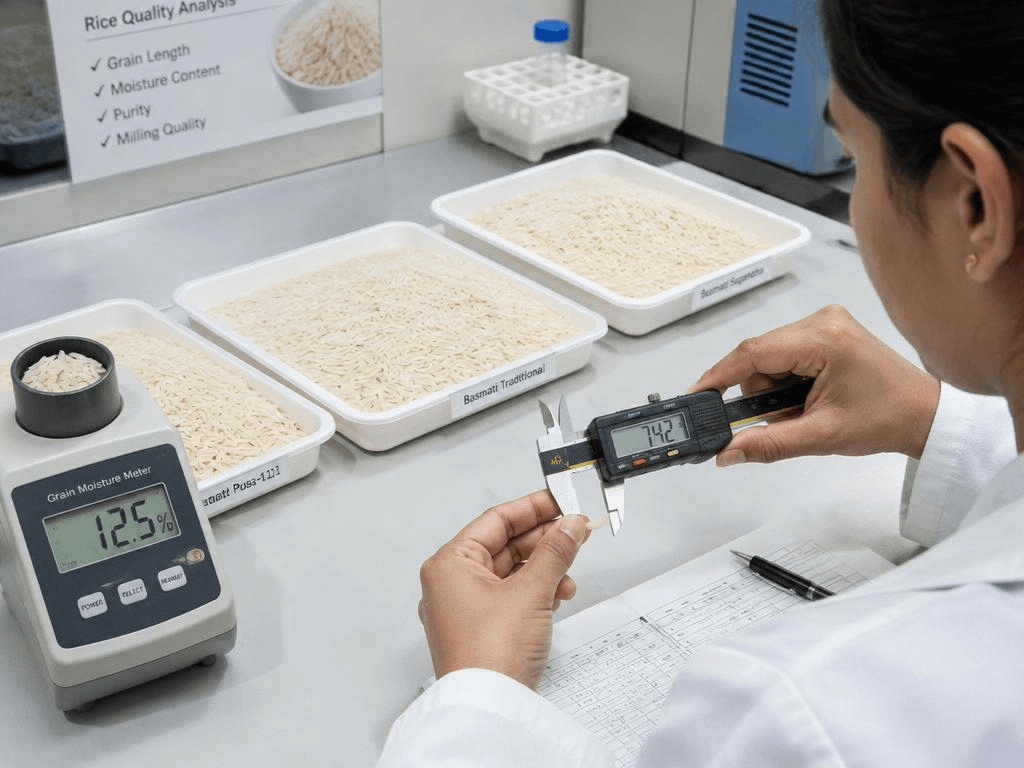
Unlike generic stock management software, Lot linkage is the exclusive feature of rice mill ERP software, which allows you to track a particular lot of paddy from the milling process to transfer and dispatch, and maintain the quality-test data with it.
If a buyer places an order for 1,000 MT of Basmati basmati rice with a moisture content and length requirement, then your dispatch team should not only be aware that 1,000 MT is available in your warehouses, they should also be able to say which lots of rice in which location are available and how much of each lot is available. That answer is only possible with lot level traceability and a phone call to each warehouse manager to verify the cross reference with the lab notebooks.
Using a rice inventory management software to ensure that the quality record will be maintained at the lot level:
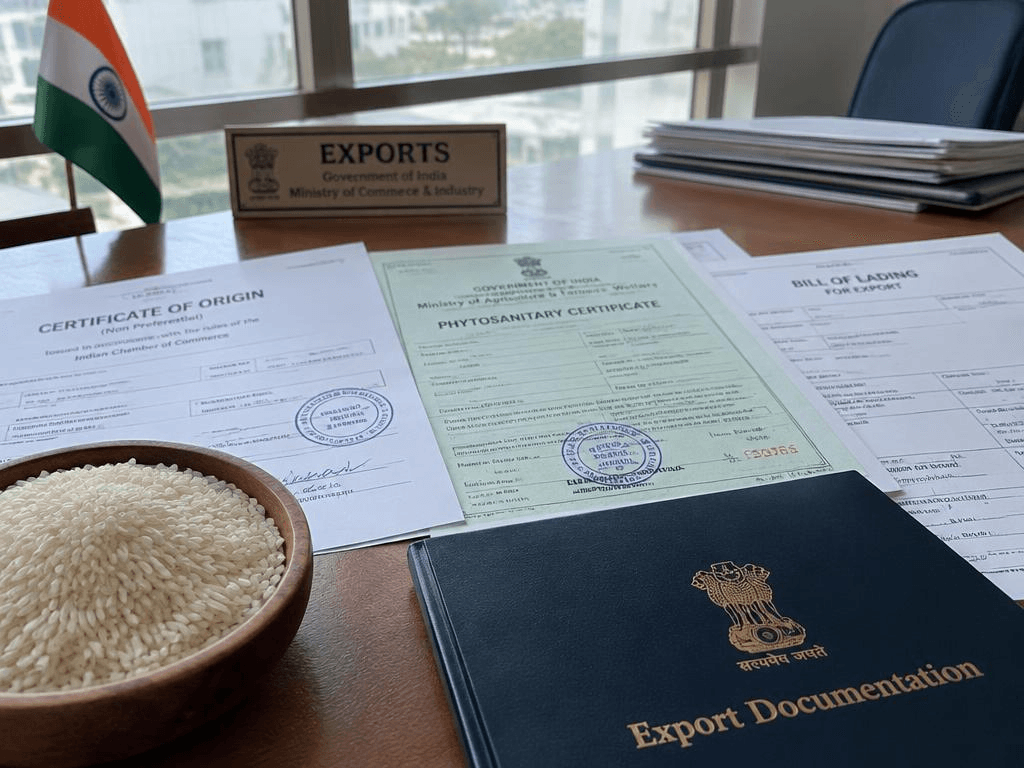
That traceability chain is the same as the one upon which APEDA registration and export compliance documentation rely, but not as a standalone documentation process as such but rather as a result of the same system you use for your everyday stock management.
Learn about Export Compliance & Documentation with AgroBrain
Developing a Rice Operation's Integrated Stock Management System
The first question that immediately springs to the mind of most rice exporters is; “Can we install a WMS module to our existing system?” Maybe for a single product operation. When it comes to a multi-location rice operation that involves procurement, milling, tracking of byproducts, and dispatching of exports, the answer is typically no, and not so much because of the technical challenge of integration, but because of generic warehouse inventory management software not being designed around the stock events relevant to a rice mill.
A paddy purchase is not a purchase order in the ERP sense but rather it is a purchase associated with a gate entry, a gate entry associated with a weigh bridge reading, a weigh bridge reading associated with a moisture test, a moisture test associated with a length test, and a length test associated with a lot number which then follows the material through all future steps. If the stock management software does not reflect that relationship at the point of entry, it doesn't have the data it needs for lot-level dispatch allocation, byproduct tracking or compliance documentation later on.
What a common system of multi warehouse inventory management for rice should really be:
This is a multi-location by design for AgroBrain's rice inventory management software, which includes a lot of linkage from gate entry to export documentation.
Track multi-warehouse on your own data
Book a free demo of AgroBrain's inventory module with your warehouse structure.
Conclusion
A multi-location rice inventory dissipates in a known manner: broken lot data, byproduct loss, lags in transfers between locations, and gaps in allocating for dispatch. The problem of counting is solved with a generic set of tools in the warehouse.
What rice exporters require is a system that is defined by rice stock events, from the first weigh bridge to the last gate-out, and maintains the identity of the lot, quality data and physical location. That is what rice mill ERP software for the rice industry offers, and why it's different from horizontal warehouse solutions which see rice like it's another product.
Frequently Asked Questions
What is the Multi Warehouse stock management of rice mills?
Multi warehouse inventory management for rice mills involves keeping records of raw paddy, milled rice, and other by-products on various physical locations, various rice mills, various godowns and various dispatch locations in one and the same connected system. It must have lot-level traceability to track each stock movement and have the quality data from the lot from which stock is originally moved.
What is the mechanism of real time tracking of the inventory in rice godowns?
In the case of rice, real-time inventory tracking records each inventory event as they happen, such as the entry into the warehouse, unloading, milling, transfer, and exit from the gate, and updates all the inventory views immediately. This removes the "lag window", where the rice is in transit but not seen at either location, the most frequent cause of inaccurate inventories in multi-site rice operations.
Is generic Warehouse Management Software suitable for Rice Mill?
Product counts and locations are managed by generic warehouse inventory management, but it is unable to model the transformation chain for rice processing, the by-products, the quality information at the lot level, and the compliance documentation based on the traceability. Rice mill ERP software is designed around these particular stock events instead of considering them as edge cases.
What is the difference between Stock management software and Rice mill ERP software?
Stock Management Software monitors inventory and locations. Rice mill ERP software also stores the information about the raw material's conversion into the finished product and byproduct throughout the process, and links with the stock information to procurement, production, and export records in a single integrated system.
How does inventory management for rice mills handle byproducts like bran and husk?
The quantity of rice that is broken, separated or lost during the milling process should be recorded in the rice mills' inventory, based on the weight, where and when the production batch was made, and not at month-end. This is important not only for the accurate determination of the stock but also for profitability because the byproducts can be sold separately and have their own worth, and they are frequently stored and sold separately from the milled rice.